
Defense contractors pursuing CMMC 2.0 compliance must satisfy 110 NIST SP 800-171 requirements across 14 security families before certification. Anderson-Reaux Technical Solutions guides Defense Industrial Base suppliers through gap analysis, policy development, and control validation, moving organizations toward Level 2 readiness on a timeline aligned with industry standards, delivering a defensible certification package for contracting officers and primes.
Why Does CMMC 2.0 Matter for Contractors?
Federal cybersecurity rules now carry the weight of contract law for defense suppliers. The Cybersecurity Maturity Model Certification (CMMC) sets security requirements for every organization in the Defense Industrial Base that handles Federal Contract Information or Controlled Unclassified Information (CUI). Losing sight of these requirements puts active contracts, not just future bids, at risk.
The timeline removes any ambiguity about urgency. The CMMC Program Final Rule, codified at 32 CFR Part 170, took effect on December 16, 2024. A companion rule under the Defense Federal Acquisition Regulation Supplement, referenced as DFARS 252.204-7012, makes CMMC contractually enforceable and is rolling out in phases through 2025.
Is CMMC 2.0 Actually Required to Win Contracts?
Yes, for many solicitations it already is. Organizations may need to demonstrate CMMC compliance as a precondition of contract award, and again throughout performance. A contractor without documented evidence of implemented controls faces exclusion from awards regardless of technical capability.
What Happens Without a Clear Compliance Plan?
Gaps surface during assessment, not before, and by then the contract is often already on the line. A structured CMMC 2.0 compliance checklist helps small and mid-sized contractors track control implementation against the final rule’s expectations before an assessor or prime ever asks.
Three consequences follow for contractors that delay:
- Exclusion from solicitations requiring CMMC as an award condition
- Contract performance disruptions tied to DFARS clause enforcement
- Lost standing with primes who vet subcontractor cybersecurity posture directly
Anderson-Reaux Technical Solutions serves the Defense Industrial Base nationwide, helping contractors map these requirements to real operational practice.

What Sets NIST 800-171 Apart From CMMC?
NIST SP 800-171 compliance for defense contractors defines the security controls a contractor must implement. CMMC measures whether those same controls hold up under outside review. The distinction matters for any defense contractor preparing for an upcoming assessment.
NIST SP 800-171 organizes its requirements into 110 controls spread across 14 security requirement families, covering areas like access control, incident response, and system monitoring. These families give contractors a structured map of obligations tied to protecting Controlled Unclassified Information (CUI). CMMC does not rewrite this map. It builds on top of it.
Is CMMC Level 2 just NIST 800-171 by another name?
Not quite. CMMC Level 2 requirements rest directly on the 110 security requirements already defined in NIST SP 800-171. The difference lies in verification: CMMC adds the scrutiny layer that confirms those controls function as documented, not just that they exist on paper.
Why do contractors get tripped up treating the two as identical?
The frameworks overlap heavily, which leads many compliance teams to assume one covers the other completely. That assumption creates gaps. Those gaps tend to surface during assessments, when evidence and documentation get examined line by line rather than taken on faith.
A contractor working through a CMMC 2.0 compliance checklist needs both layers addressed: documented implementation under NIST SP 800-171, and demonstrable evidence ready for CMMC-level scrutiny. Skipping either layer, or assuming compliance with one satisfies the other, is where most readiness gaps originate.
What Does a CMMC 2.0 Checklist Include?
A complete CMMC 2.0 compliance checklist covers technical safeguards, written policy, and proof that controls function as intended. Defense contractors across the Defense Industrial Base face reviews built around readiness, not a one-time technical setup.
A checklist built on NIST SP 800-171 compliance for defense contractors does more than list required security controls. Reviewers expect proof those controls operate daily and hold up under scrutiny. Organizations pursuing CMMC compliance must demonstrate that required security controls are implemented, operating as intended, and backed by documentation and evidence. A policy sitting in a drawer carries no weight if logs, configurations, and staff practice tell a different story.
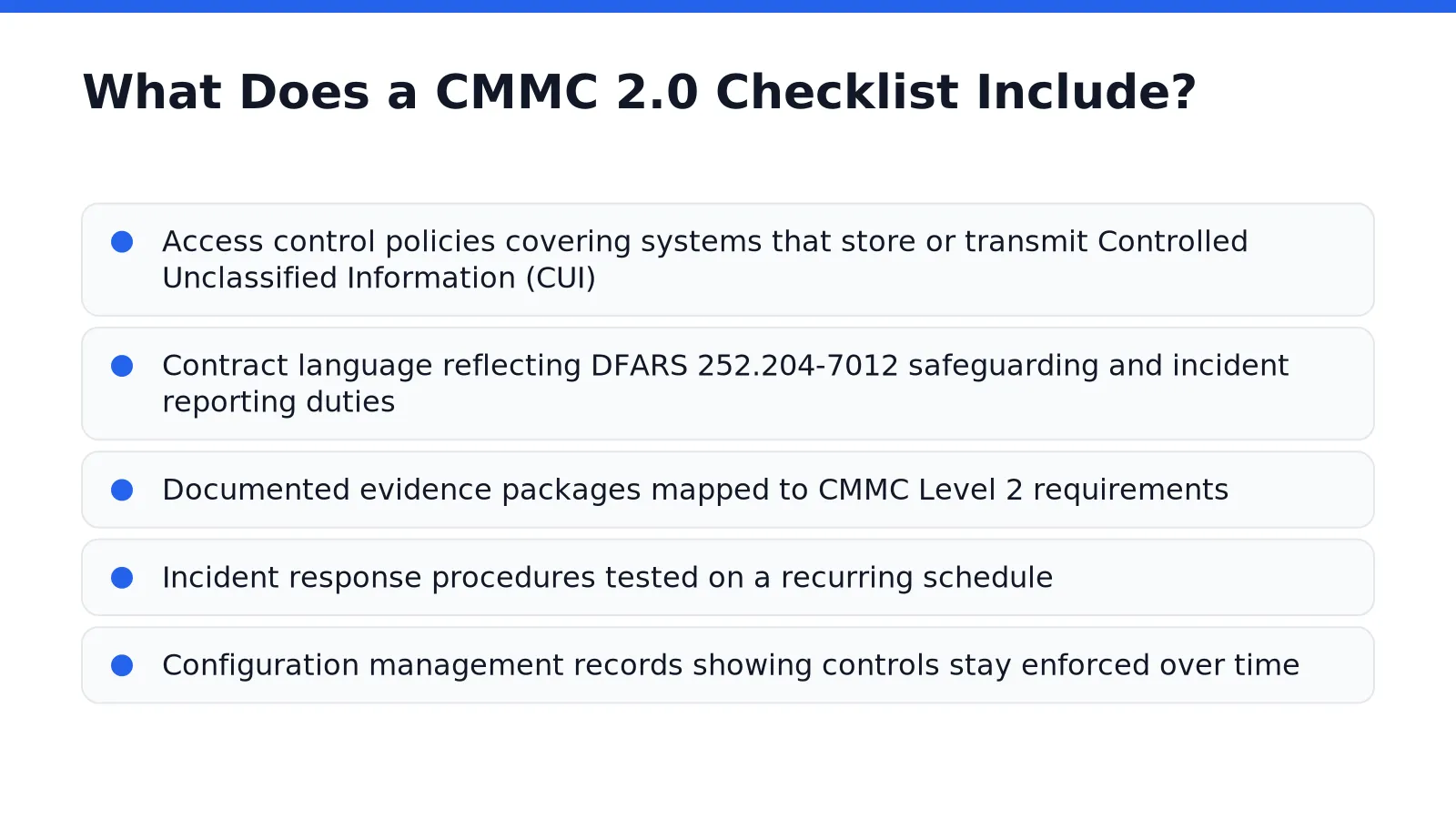
A practical checklist typically covers:
- Access control policies covering systems that store or transmit Controlled Unclassified Information (CUI)
- Contract language reflecting DFARS 252.204-7012 safeguarding and incident reporting duties
- Documented evidence packages mapped to CMMC Level 2 requirements
- Incident response procedures tested on a recurring schedule
- Configuration management records showing controls stay enforced over time
Why Do So Many Contractors Struggle With CMMC Readiness?
Technical safeguards alone rarely satisfy a CMMC review. Many contractors find CMMC difficult because assessments test readiness, not just whether a control was installed once. Passing requires more than technical safeguards; documentation and evidence carry equal weight in the outcome.
What Happens After Initial Setup Is Complete?
Compliance does not end once controls go live. Maintaining it demands ongoing operational discipline, consistent documentation management, and continuous assessment readiness. Contractors that treat the checklist as a one-time project risk falling out of alignment before the next review cycle arrives.

How Do Contractors Meet Level 2 Requirements?
Defense contractors satisfy CMMC Level 2 requirements through a structured process of assessment, documentation, and continuous monitoring, not a single audit event. Enforcement is no longer theoretical. CMMC v2.0 vs NIST 800-171: Understanding the Differences reports that CMMC enforcement began in 2025 through DFARS clause 7021, shifting the program from written policy to active contract enforcement across the defense supply chain. More than 220,000 Defense Industrial Base contractors fall within the scope of these obligations, making readiness a shared challenge across the sector rather than an isolated concern.
What does a defense contractor actually need to do first?
Most contractors start by mapping where Controlled Unclassified Information (CUI) lives inside their systems. From there, obligations tied to DFARS 252.204-7012 come into focus. That clause anchors the safeguarding and incident-reporting duties contractors already carry. A disciplined CMMC 2.0 compliance checklist keeps these steps ordered instead of scattered across departments.
A.R.T.S supports this path with services built around each stage of readiness:
- Gap analysis to identify where current controls fall short
- Consulting on NIST SP 800-171 compliance for defense contractors
- Policy development aligned to required safeguards
- Ongoing support and system maintenance
- Staff training to reduce breach exposure
How does A.R.T.S verify readiness before an assessment?
Verification happens through control-by-control review, not a single checklist pass. A.R.T.S validates more than 10,000 controls to confirm maturity and audit readiness across a contractor’s environment.
This depth of validation matters because missed controls rarely surface until an assessor finds them. Catching gaps early keeps contracts, not just certifications, intact.
Detailed Breakdown of the 14 NIST SP 800-171 Requirement Families
Understanding each security family is crucial for comprehensive readiness. Below is a technical overview paired with practical guidance for implementing and maintaining controls within each area:
- Access Control (AC): Implement role-based access control, session management, and least privilege. Regularly audit access logs and enforce multifactor authentication for all CUI-related systems.
- Awareness and Training (AT): Conduct initial and ongoing cybersecurity training tailored to DIB requirements. Include phishing simulations and policy acknowledgments to ensure compliance.
- Audit and Accountability (AU): Enable and monitor detailed audit logs capturing user activities. Apply automated tools for real-time alerting on anomalous behavior affecting CUI.
- Configuration Management (CM): Maintain documented configuration baselines. Employ automated scanning for unauthorized changes and periodically review to align with security best practices.
- Identification and Authentication (IA): Enforce unique user identification and robust authentication methods. Password policies should mandate complexity and frequent changes in line with federal guidelines.
- Incident Response (IR): Develop an incident response plan aligned with DFARS requirements. Conduct tabletop exercises quarterly, with clearly defined roles, communication flows, and escalation paths.
- Maintenance (MA): Conduct scheduled system maintenance with documented approval workflows. Employ secure methods for remote maintenance and track all maintenance activities.
- Media Protection (MP): Implement encryption on all portable media and secure disposal procedures. Maintain an inventory of media containing CUI and enforce access restrictions.
- Personnel Security (PS): Screen personnel with access to CUI and apply ongoing monitoring. Conduct exit interviews and revoke access promptly upon personnel departure.
- Physical Protection (PE): Control physical access to facilities and systems housing CUI using badges, surveillance, and visitor logs. Perform regular security audits of physical controls.
- Recovery (RE): Establish backup and disaster recovery procedures. Test recovery plans semiannually and validate that critical data restoration meets time-to-recovery objectives.
- Risk Assessment (RA): Perform comprehensive risk assessments at least annually. Incorporate threat intelligence and vulnerability scans to prioritize remediation efforts.
- Security Assessment (CA): Conduct formal security assessments prior to authorization and post-major changes. Document findings and ensure corrective action plans are implemented timely.
- System and Communications Protection (SC): Use encryption for data in transit and at rest. Segregate networks to isolate CUI processing and monitor communication channels for unauthorized activity.
- System and Information Integrity (SI): Deploy anti-malware solutions, apply security patches proactively, and monitor systems for integrity violations continuously.
Step-by-Step CMMC 2.0 Level 2 Compliance Checklist
- System Security Plan (SSP) Creation: Document all systems processing CUI, detailing implemented controls linked to each NIST 800-171 requirement family. Include organizational roles, responsibilities, and interconnections.
- Plan of Action and Milestones (POA&M) Boundaries: Identify known weaknesses or partial controls. Develop an actionable remediation plan with clear timelines and resource allocation to resolve findings before assessment.
- Supplier Performance Risk System (SPRS) Scoring Methodology: Understand how control maturity affects your SPRS score used by DoD. Ensure that all corrective actions from previous audits are resolved and documented to maintain or improve scoring.
- C3PAO Third-Party Assessment Preparation: Prepare comprehensive evidence packages including reports, logs, training records, and audit trails. Schedule readiness reviews and mock assessments to simulate the official evaluation environment.
- Contractual Controls and Flow Downs: Review DFARS clauses 252.204-7012, 252.204-7019, and 252.204-7020 to ensure contract language and subcontractor relationships meet obligations for safeguarding and incident reporting.
- Ongoing Monitoring and Incident Reporting: Develop processes that guarantee timely incident detection, documentation, and reporting as mandated by DFARS. Automate alerts and maintain a communication plan for stakeholders.
- Continuous Staff Training and Awareness: Implement regular refresher training programs with records available for assessment. Ensure that all personnel handling CUI understand their responsibilities under CMMC and DFARS.
- Periodic Internal Assessments: Conduct quarterly or biannual internal audits to validate control effectiveness and readiness for external assessments.
Integrating DFARS Clauses and Handling CUI/FCI
DFARS 252.204-7012 establishes safeguarding requirements and incident reporting duties for CUI. Contractors must implement NIST 800-171 controls and report cyber incidents within 72 hours to the DoD’s Cybersecurity Incident Reporting system.
DFARS 252.204-7019 and 252.204-7020 complement this by requiring subcontractor flow down of cybersecurity requirements to maintain consistent risk posture throughout the supply chain.
Handling Controlled Unclassified Information (CUI) and Federal Contract Information (FCI) demands strict access controls, encryption, and secure storage practices. Contractors must maintain clear data inventories, documenting where and how such information is processed, transmitted, or stored. Data minimization and regular sanitization are recommended best practices.
Expert Commentary and Practical Audit Tips for Defense Industrial Base SMBs and Prime Contractors
Industry experts emphasize that early preparation is critical to avoid costly contract delays. Implementing a continuous monitoring program paired with evidence-ready documentation reduces surprises during audits.
Audit tips include maintaining a cross-functional compliance team, leveraging automated compliance dashboards, and ensuring logs are immutable and backed up securely. Remediation timelines typically recommend addressing low-risk findings within 90 days, medium risk within 60 days, and high risk immediately.
Risk mitigation strategies should prioritize patch management, staff training on phishing and insider threats, and regular vulnerability scanning integrated with incident response protocols.
Who Can Help Contractors Close Compliance Gaps?
Anderson-Reaux Technical Solutions closes compliance gaps for defense contractors who lack an internal security team. A complete, defensible certification package gives contracting officers and prime contractors a clear record to review. Small and mid-sized suppliers across the Defense Industrial Base can meet cybersecurity requirements without hiring dedicated compliance staff.
Many contractors treat CMMC 2.0 compliance checklist work and NIST SP 800-171 compliance for defense contractors as the same task. That assumption costs real money when an assessment exposes overlooked requirements. Confusing the two frameworks creates gaps that surface at the worst possible moment, during a review tied to a live contract.
Why does jargon-free communication matter for compliance work?
Technical language slows down decision-making inside a small business. Compliance work delivered in a straightforward, jargon-free manner keeps owners, IT managers, and compliance officers informed without requiring them to decode security terminology. Clear communication, paired with a strategic partnership approach, lets contractors stay focused on operations while cybersecurity work moves forward in parallel.
What experience should a compliance partner bring?
Guidance on CMMC Level 2 requirements demands depth, not general familiarity. Anderson-Reaux Technical Solutions applies over three decades of combined experience to the nuances of CMMC 2.0, including:
- Interpretation of control requirements tied to Controlled Unclassified Information (CUI)
- Alignment with obligations referenced under DFARS 252.204-7012
- Documentation practices built for assessment scrutiny, not just technical implementation
Expert Cybersecurity & Compliance Practitioner Note
Authored by Certified CMMC Assessors, this note provides crucial insights into common pitfalls during C3PAO assessments and CUI scoping challenges that frequently lead to non-compliance:
- C3PAO Assessment Pitfalls: Over-reliance on outdated SSPs and incomplete evidence packages lead to extended reviews and failed assessments; insufficient internal audit trails often reveal undocumented control failures.
- Common Non-Compliance Traps in CUI Scoping: Contractors often under-scope their environment, omitting interconnected systems that process CUI indirectly; failure to include cloud services or remote access endpoints in scope triggers critical findings.
- Exact Evidence Artifacts Required for DIBCAC Audits: Hardened System Security Plans linked directly to configuration baselines; time-stamped logs demonstrating multifactor authentication enforcement; documented and tested incident response playbooks; cryptographic module validation certificates (FIPS 140-3); and traceable training records aligned to policy updates.
This expert view emphasizes that comprehensive preparation with documented, demonstrable evidence aligned to CMMC 2.0 ensures fewer surprises and accelerated certification.
Comprehensive Comparison Table: NIST SP 800-171 Rev 2 vs Rev 3, CMMC 2.0 Levels, and Assessment Types
Concrete Implementation Examples for High-Risk Control Families
- Multi-Factor Authentication (MFA) Enforcement Across Legacy Systems: Implement hardware tokens or mobile authenticators integrated with legacy VPN and remote desktop protocols, ensuring all access points to CUI repositories require MFA regardless of application vintage.
- FIPS 140-3 Validated Cryptographic Modules: Deploy encryption tools and TLS libraries certified under FIPS 140-3 standards for all data-at-rest and in-transit, replacing legacy cryptography components that do not meet updated security baselines.
- Centralized SIEM Log Retention (14+ CFR Requirements): Establish a Security Information and Event Management (SIEM) platform centralizing logs from endpoints, servers, and network devices, retaining logs immutable for a minimum of one year as mandated by CFR while supporting real-time alerting for anomalous CUI access.
- Incident Reporting Timelines to DC3 Within 72 Hours Under DFARS 252.204-7012: Integrate automated incident detection tools with defined escalation playbooks to ensure notification of cybersecurity incidents to the Department of Defense Cyber Crime Center (DC3) within the strict 72-hour timeline following initial discovery.
Definitive 6-Phase Contractor Readiness Roadmap with Milestone Deliverables
- Scoping: Define CUI boundaries, identify assets and systems in scope; deliverable: comprehensive CUI inventory and environment diagram.
- Gap Assessment: Perform detailed control evaluation against NIST 800-171 and CMMC Level 2 standards; deliverable: formal gap analysis report outlining non-compliant controls.
- SSP/POA&M Development: Create and maintain a System Security Plan detailing implemented controls, alongside a Plan of Action & Milestones addressing remediation timelines; deliverable: finalized SSP and POA&M documents ready for assessment.
- Remediation: Implement corrective actions addressing identified gaps, including technical fixes and policy updates; deliverable: documented remediation evidence and updated control configurations.
- Mock Assessment: Conduct pre-assessment reviews simulating C3PAO audits to validate readiness and uncover residual vulnerabilities; deliverable: mock audit report and remediation plan for uncovered issues.
- Formal C3PAO Audit: Undergo official third-party appraisal with CMMC-accredited organization; deliverable: certification report confirming compliance status and award eligibility.
Integrating DFARS Clauses and Handling CUI/FCI (Revised with Implementation Examples)
DFARS 252.204-7012 establishes safeguarding requirements and mandates the reporting of cyber incidents within 72 hours to the Department of Defense Cybersecurity Incident Reporting system (DC3). Contractors must implement NIST 800-171 controls using FIPS 140-3 validated cryptographic modules and demonstrate multi-factor authentication enforcement across network and legacy systems. Incident response plans must integrate these timelines with defined escalation paths.
DFARS 252.204-7019 and 252.204-7020 require subcontractor flow down of cybersecurity requirements to ensure consistent risk posture across the supply chain. Centralized SIEM systems retaining logs for a minimum of one year meet regulatory audit requests and support incident investigations.
Proper handling of Controlled Unclassified Information (CUI) and Federal Contract Information (FCI) demands comprehensive scoping, including cloud service providers and remote endpoints. Encryption of data at rest and in transit, along with strict access controls employing MFA, form the security backbone required by these clauses.
Conclusion
In closing, defense contractors operating within the federal supply chain must recognize that CMMC 2.0 compliance and NIST SP 800-171 readiness represent non-negotiable operational requirements. Organizations that establish comprehensive, well-documented cybersecurity frameworks aligned with these standards protect sensitive defense information while demonstrating organizational maturity to federal partners. By implementing comprehensive policies, conducting rigorous control validation, and maintaining ongoing compliance monitoring, contractors position themselves to navigate evolving threat landscapes with confidence and sustain their competitive standing within the defense industrial base.
Next Steps & Compliance Resources
To advance your organization’s cybersecurity posture and ensure smooth compliance with CMMC 2.0 requirements, consider the following resources and actions:
- Explore transparent CMMC compliance pricing options tailored to your organization’s size and needs to budget accordingly.
- Explore our cybersecurity insights for in-depth articles, guides, and best practices to stay informed about evolving threats and security strategies.
- Conduct a preliminary readiness check through a detailed gap assessment to identify vulnerabilities before formal audits.
- Learn more about Tech Solutions and our expertise in guiding defense contractors through successful CMMC 2.0 compliance journeys.