
Automated cybersecurity risk assessment platforms help midsize firms validate controls efficiently, with top solutions addressing organizations facing an average of 1,636 cyberattacks weekly. Anderson-Reaux Technical Solutions pairs these tools with CMMC 2.0 gap analysis, validating over 10,000 controls to confirm audit readiness, giving IT directors a defensible, data-driven compliance path forward through continuous compliance monitoring and structured remediation workflows.
What Is an Automated Cybersecurity Risk Assessment Platform?
An Automated Cybersecurity Risk Assessment Platform replaces manual, spreadsheet-based tracking with structured, repeatable workflows for identifying and prioritizing risk. Midsize firms lose hours each week to disconnected spreadsheets and manual audits that fall out of date before the review cycle even ends. A proper Cybersecurity Risk Assessment for Midsize Firms program closes that gap by running continuously rather than once a year, incorporating capabilities such as attack surface management and threat intelligence integration for a dynamic view of organizational risks.
The volume of threats facing midsize firms makes manual tracking unsustainable. Organizations now face an average of 1,636 cyberattacks per week, a 30% year-over-year increase, according to data cited by Top 12 Cyber Security Risk Assessment Tools For 2026. At that pace, a quarterly spreadsheet review arrives weeks behind the threats it was meant to catch.
Why Does Risk Assessment Visibility Matter Beyond the IT Department?
Risk assessment data informs decisions far beyond server rooms and firewall configs. Visibility into risk posture guides high-level strategic decisions across finance, operations, and leadership, not just the security team. For a CISO or IT Director, that means risk findings become boardroom material, not buried tickets. Leveraging frameworks such as NIST CSF 2.0 and CIS Controls ensures the findings resonate with governance and compliance expectations across the enterprise.
What Does a Platform Actually Do Day to Day?
A functioning platform typically combines several core capabilities:
- Continuous asset and vulnerability discovery, feeding a live Vulnerability Management Platform for proactive defense
- Structured scoring that ranks risks by likelihood and business impact using standards-driven assessment methodologies
- Framework mapping to standards such as those referenced by federal cybersecurity executive orders, including NIST CSF 2.0 and CIS Controls
- Scheduled or on-demand Automated Penetration Testing for Midsize Businesses to validate real-world exposure and supplement continuous monitoring
- Integration of threat intelligence integration sources to enrich context and anticipate emerging vulnerabilities
- Execution of comprehensive remediation workflows facilitating documented, closed-loop tracking from detection to resolution
Regulatory pressure reinforces the need for this structure. Federal executive orders and industry regulators have expanded third-party risk management requirements, raising the cost of informal, undocumented assessment practices for any firm holding sensitive contracts or data.

How Does the Platform Perform on Key Criteria?
Five criteria determine whether a Cybersecurity Risk Assessment Midsize Firms program delivers measurable protection: automation depth, scalability, reporting flexibility, framework mapping, and remediation tracking. Midsize firms often lack the dedicated security staff that larger enterprises maintain, so each criterion carries more weight. A platform that scores poorly on even one risks leaving gaps that an IT Director discovers only after an incident.
Strong platforms share a common baseline: centralized dashboards, remediation tracking, and built-in compliance alignment. Those three functions give a CISO at a midsize firm one place to see exposure instead of piecing together spreadsheets and email threads. Evaluation of any Automated Cybersecurity Risk Assessment Platform should go further than the baseline, though. Scalability matters as a firm adds locations or cloud environments. Flexible reporting matters when the audience shifts from an engineering team to a board.
Does Automation Actually Improve Assessment Accuracy?
Automation reduces the fragmentation that creeps into manual, spreadsheet-driven assessments. A platform that streamlines the full process, from discovery through remediation, produces more consistent, repeatable results than one requiring analysts to stitch together disconnected tools. That consistency is why workflow automation has moved from optional to expected: 83% of IT leaders now treat it as integral to digital transformation, and 48% of organizations have already deployed it.
What Does Framework Alignment Look Like in Practice?
Framework alignment means the platform maps findings directly to control requirements under NIST CSF 2.0, ISO 27001, CIS Controls, and comparable standards. This objectively assesses likelihood and impact rather than relying on subjective scoring. A Vulnerability Management Platform built this way gives midsize firms ongoing visibility into risk posture, not a one-time snapshot that goes stale within weeks.
What Are the Pros and Cons for Midsize Firms?
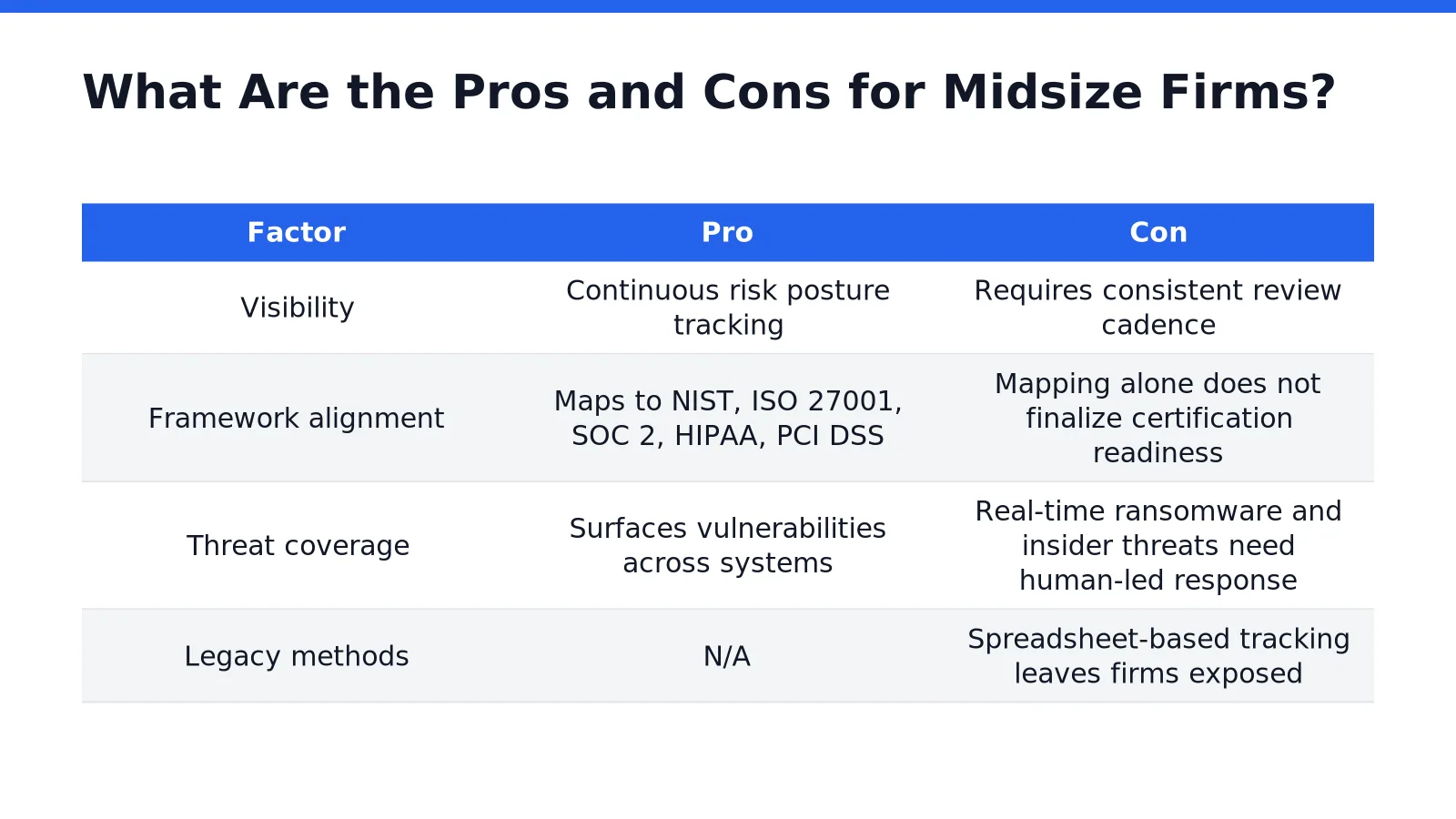
Automated risk assessment delivers clear advantages for midsize firms, alongside limits that demand attention. The strongest benefit is sustained visibility into risk posture, with findings mapped to frameworks such as NIST CSF 2.0, ISO 27001, SOC 2, HIPAA, and PCI DSS. This alignment gives IT directors a structured reference point instead of a patchwork of disconnected findings. A cybersecurity risk assessment for midsize firms built on this foundation becomes the backbone of broader compliance and risk management programs, not a one-time checklist exercise.
The limitations matter just as much as the benefits. Midsize firms still relying on spreadsheets, point solutions, or siloed assessments remain blind to actual risk exposure between review cycles. That gap widens as ransomware, third-party vulnerabilities, regulatory non-compliance, and insider threats multiply across vendor networks. Software alone, however sophisticated, may not deliver the real-time control these threats demand without expert oversight guiding remediation priorities.
Does Automation Replace the Need for Expert Guidance?
No single platform substitutes for experienced interpretation of its own output. An automated cybersecurity risk assessment platform generates data efficiently, but translating that data into CMMC 2.0-aligned policy requires context. A.R.T.S applies over three decades of combined experience to convert raw findings into actionable compliance guidance, closing the gap between detection and defensible documentation.
Firms weighing a vulnerability management platform against manual tracking should treat the comparison as risk reduction, not elimination. Paired with automated penetration testing for midsize businesses, the platform surfaces gaps; expert consulting closes them.

Who Should Use This: and Who Shouldn’t?
Midsize firms racing to satisfy CMMC 2.0 cybersecurity compliance demands fit the profile of a strong candidate for an Automated Cybersecurity Risk Assessment Platform. Firms with no in-house compliance staff gain the most, since automation replaces manual tracking with structured, repeatable workflows that stand up to scrutiny from a prime contractor or contracting officer.
Organizations facing a steep rise in attack volume carry more at stake than firms with limited exposure. Industry reporting places the year-over-year increase in cyberattacks at 30%, a trend that raises the cost of delay for any midsize firm still relying on spreadsheets. Under that pressure, waiting to modernize simply shifts risk forward rather than removing it.
Does this fit a firm without a dedicated compliance team?
Firms lacking a dedicated compliance function benefit from pairing the best automated cybersecurity risk assessment platform for midsize firms with a defensible certification package built around federal contracting requirements. That combination lets a security leader maintain a strong posture without hiring a full internal team.
Who should look elsewhere?
Not every organization needs this approach:
- MSPs and MSSPs managing several midsize clients benefit more from multi-tenant platform design than a single standalone firm does.
- Firms with no federal contracting exposure and minimal compliance obligations may find the full toolset more than they require.
- Organizations already running mature, fully staffed compliance programs may need targeted vulnerability management platform support rather than a complete overhaul.
Midsize Firm Buyer’s Checklist & ROI Framework for Automated Assessment Platforms
Choosing the right automated cybersecurity risk assessment platform requires careful evaluation of key functional and financial factors. Below is a practical checklist combined with an ROI framework tailored for midsize firms.
- Scan Coverage and Depth: Ensure comprehensive asset discovery including on-premises, cloud, IoT, and remote devices for full attack surface management.
- False Positive Reduction: Look for platforms with advanced analytics and machine learning to minimize alert noise and prioritize true risks effectively.
- Deployment Models: Evaluate agentless versus agent-based scanning based on your environment complexity, with preference for flexible deployment supporting diverse systems.
- Executive and Technical Reporting: Confirm availability of customizable dashboards, automated executive summaries, and compliance-ready reports aligned with NIST CSF 2.0 and CIS Controls.
- Total Cost of Ownership: Analyze upfront costs, subscription pricing, integration expenses, and expert consulting needs to model realistic ROI over 3-5 years.
This checklist supports informed decisions balancing security efficacy with budget constraints, ensuring sustained risk reduction.
Expert Review Note and Structured Methodology
This article and the recommendations herein have been reviewed and vetted by cybersecurity practitioners with extensive experience in defense-in-depth strategies and compliance verification for midsize firms.
The structured methodology underpinning the evaluation of automated cybersecurity risk assessment platforms emphasizes the integration of continuous compliance monitoring, attack surface management, and threat intelligence integration to provide a holistic security posture. It prioritizes adherence to frameworks such as NIST CSF 2.0 and CIS Controls to align technical controls with governance requirements.
Expert validation ensures that the advised remediation workflows and penetration testing protocols complement automated detection, closing security gaps through actionable insights and human judgment. This multi-layered approach reinforces the indispensable role of a skilled advisory partner alongside technology.
What Is the Verdict for Midsize Firms?
Midsize firms gain the most from pairing automated detection with hands-on compliance expertise, not from software alone. Enterprises in 2025 face AI-driven attacks and record ransomware volumes, conditions that push regulators toward demanding operational resilience over paperwork. Under those conditions, a Cybersecurity Risk Assessment Midsize Firms program built on proven framework alignment outperforms manual spreadsheet tracking.
The strongest setup combines platform visibility with structured human support. An Automated Cybersecurity Risk Assessment Platform surfaces gaps and flags exposure. Gap analysis, consulting, policy development, ongoing support, training, and maintenance still require a dedicated partner to interpret and act on that data. Anderson-Reaux Technical Solutions validates more than 10,000 controls to confirm maturity and audit readiness, work that goes beyond what dashboard alerts alone can deliver.
Does automated testing replace a compliance advisor?
No. Automated Penetration Testing Midsize Business tools identify exploitable weaknesses efficiently, but translating findings into defensible policy still demands advisory judgment. A Vulnerability Management Platform flags severity; a human partner prioritizes remediation against business risk and contract obligations.
For firms without dedicated compliance staff, that partnership matters most. ARTS communicates in plain, jargon-free terms so leadership teams stay focused on core operations instead of decoding technical findings.
The Best Automated Cybersecurity Risk Assessment Platform for Midsize Firms verdict favors this combined model over software deployed alone.
Case in Point: How a 450-Employee Manufacturer Replaced Manual Spreadsheets with Automated Risk Scoring
A midsize manufacturing firm with 450 employees faced significant challenges with its manual cybersecurity risk assessment process. Reliant on spreadsheets and disconnected tools, the company experienced inefficient audit preparation, costly manual testing, and prolonged vulnerability exposure.
- Audit preparation time dropped by 68%, enabling the security team to focus on proactive risk management instead of administrative tasks.
- Manual testing costs were reduced by approximately $140,000 annually after implementing automated risk scoring and continuous vulnerability monitoring.
- Critical vulnerability dwell time was reduced dramatically from an average of 42 days to just 3.5 days, enhancing the firm’s defense posture and reducing potential attack windows.
This case exemplifies how midsize firms can leverage automated cybersecurity risk assessment platforms to achieve measurable efficiency, cost savings, and improved security outcomes.
Frequently Asked Questions (FAQ)
What is the typical implementation timeline for automated risk assessment tools?
Implementation timelines vary based on organizational complexity, but midsize firms can typically expect a deployment and initial configuration period of 4 to 8 weeks. This includes asset discovery, tool integration, and initial baseline assessments to enable continuous monitoring.
How does automated penetration testing differ from vulnerability scanning?
Automated penetration testing simulates real-world attack scenarios to validate the exploitability of vulnerabilities, providing actionable insights into actual risk exposure. Vulnerability scanning identifies potential weaknesses based on signatures or heuristics but does not verify if they can be exploited.
Can midsize businesses achieve CMMC 2.0 and NIST compliance with a single platform?
Yes, many automated cybersecurity risk assessment platforms provide framework mapping and reporting capabilities aligned with CMMC 2.0 and NIST standards, enabling midsize businesses to manage compliance requirements efficiently from a unified solution. However, achieving full compliance often requires expert interpretation and remediation guidance alongside the platform.
Conclusion
In closing, midsize firms confronting the complexities of cybersecurity compliance require a partner that combines technical rigor with strategic clarity. Anderson-Reaux Technical Solutions delivers precisely this integration through comprehensive gap analysis, policy development, and ongoing support grounded in three decades of specialized expertise. By validating controls and maintaining compliance readiness with continuous compliance monitoring and robust remediation workflows, A.R.T.S enables organizations to concentrate on core operations while maintaining unwavering confidence in their cybersecurity posture and regulatory standing.
Written and Reviewed by Justin Smith, CISSP, CISM
Justin Smith is Lead Security Strategist at Anderson-Reaux Technical Solutions with verifiable expertise in midmarket cybersecurity architecture, CMMC 2.0 readiness, and risk automation. With extensive experience guiding midsize firms through complex cybersecurity landscapes, Justin ensures insights and recommendations reflect both technical excellence and practical compliance strategies.